Showing posts with label money. Show all posts

Friday, September 21, 2007

CD Laddering! It'll make you happy

I see it everynight, usually due to my late bedtime. These minutemen yelling at you on TV about how their investment strategy is different than everyone else's, and that's why you'll be rich in the morning. What you don't realize is they have a different investment strategy, you! They pay for the commercial so you call them and give them money. It's that simple, they just glorify it. If you don't believe me, stay up late tonight and watch for the infomercials. As soon as you see one, write the guys name down, go to google.com and type in his name and the word fraud. I haven't had one fail yet. So what am I getting at? SMART investing. You don't get rich overnight, very few do. It's a gradual buildup. I'm going to cover one of those ways now.

If you're at this site now, which I'm willing to bet you are, you've probably heard of a CD or Certificate of Deposit. I'm also sure that you've seen many of the meager interest rates for the short term CDs. Most people can't afford to have $5,000.00 tied up for 5 - 10 years. CD Laddering tries to help remedy this problem. How does it work? Let me show you:

You have Money($) Ch-Ching. Let's say $2,000.00, And you want to buy CD's(Certificates of Deposit, not music!). This is how CD Laddering would work. $500.00 in a 6-month, $500.00 in a 1 year, $500.00 in a 1 year 6-month, and $500.00 in a two year. When the 6-month one matures, you just reinvest it as a 2 year. What does this accomplish? It gives you a steady flow of income, about $500.00 every 6 months plus the interest earned. It also allows you to get the higher interest rate on the longer term 2 year.

As you keep reinvesting eventually all of the CDs coming in are maturing with the two year interest rate. And you're getting one every six months!

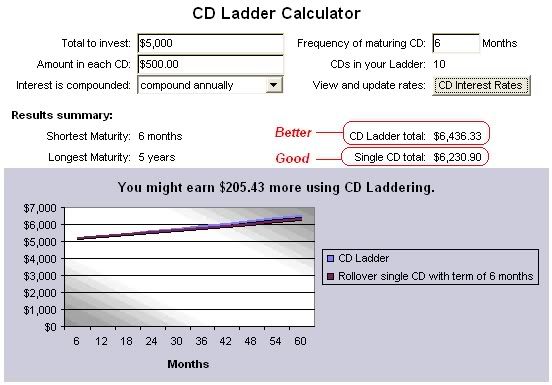
Example: This is an example I made of a CD ladder, I know, I know, I used $5,000.00 as my figure, but I just needed to show the actualy difference it can make. It's all proportional. Notice that it shows a $5,000.00 ladder VS. using a $5,000.00 single CD investment. Click the picture to enlarge.


Here are some resources so you can further investigate.
http://www.bankrate.com/brm/news/sav/20010521b.asp - Article on CD Laddering.(BankRate.com)
http://www.dinkytown.net/java/CDLadder.html - A CD Laddering calculator, remember to adjust the interest rates for the longer term CDs, you'll understand once you play with it.

Saving?

Between corporate cutbacks and limiting the number of pencils employees are allotted there’s a lot to learn about saving. The pennies really do count. But before you count the pennies you need to count the dollars. There’s a lot more to saving then just throwing money into a savings account and not looking at it. There’s a process of optimization. Fuel, Electricity, food, and many other expenses can add up, and each expense can usually have a few dollars saved. I’m going to break down many categories of expenditures that can be optimized so that you can save the most.

Fuel – I had a ‘99 Dodge Durango, which cost about 400.00 a month in gas. I now drive a ’07 Toyota Corolla, which only costs me around 100.00 to 150.00 a month and gets me about twice to three times as far. Yes the vehicle costs me more, but my monthly cost to operate my vehicle has dropped by about 33% a month. That’s a huge amount to save. You don’t need to do anything nearly as drastic as I did to save some money on gas either. Simply choosing a faster route to school or work can save a couple cents to dollars each day. Sometimes the shorter root (in terms of distance) uses more gas. You need to consider traffic, stop signs and lights. All of those require accelerating and idling. Those are the biggest gas hogs, peeling out aside.

Electricity – I have an air conditioner that operates off of a timer, it comes on about a half hour before I get home and I turn it off when I leave. Standard incandescent light bulbs (this is more of a penny saver) can be replaced by more efficient Energy saver fluorescent light bulbs. Over the course of eight thousand hours the fluorescents should save about 36.00 to 85.00 each in energy cost. Energy star appliances are also another good way to save some energy. Shutting your computer down, opening windows rather than air conditioning, switching off lights when not in use or not even needed and turning the TV off when you sleep are many other simple habits to get into that can save a ton on electricity over time. Every little bit helps.

Food – It has become far too convenient to eat out at fast food then to cook it yourself. A cheap dollar menu meal quickly turns into a 5.00 meal at McDonalds, not to mention severely unhealthy. Even if you ate twice a week at McDonalds at 5.00 a pop, that’s 40.00 a month or 480.00 a year. The truth being that each time a person eats at a fast food restaurant they spend more than 5.00, and they usually have more than one person. These expenses add up quickly.

You can easily eat at home making your own food, and each meal can cost you under two dollars. People don’t think twice when they spend a dollar on a Coke, when they could easily get 4 to five times more for 3.00 buying a two liter. Or if you want to take the healthy route you can get a gallon of purified water for as little as $0.65.That’s just a few of the ways that you can turn some expenses into savings.

You have to count the dollar and cents you spend, optimize it, then worry about the additional money you want to put in. As little as a dollar savings everyday can amount to 365.00 a year. I imagine that most people can save more than one dollar a day. Two dollars a day ant you’re up to almost $800.00. And it just keeps continuing. If there wasn’t money in counting pennies then credit card companies wouldn’t exist. Of course they do it in mass, but it’s always nice to have little extra when you need to fill the tank.

To squeeze a bit more out of your savings, save about 500 – 1000.00 and invest in a CD at a credit union(banks aren't usually able to touch a credit unions interest rates in most instances). This will allow your money to earn decent interest while preventing you from using the money, but always make sure you have some in savings for emergencies. I’ll be writing out some comprehensive articles on investing in CDs and managing savings. So until then…

I can't afford school!

A common problem that lots of students, or prospective students, have is how they can pay for college. It’s not impossible, but it takes some footwork. I’m going to highlight some important information so that it might make it easier for students to pay for school. Before you do anything on this site fill out a FAFSA (Federal Application for Student Aid) at http://fafsa.ed.gov. If you can’t because of family situations then speak with you financial aid officer at you college. They have the ability to help students out in tight situations. Their whole job is to take into account special circumstances in people’s lives. It may take a little more time but it will be well worth it when you’re done with college and able to support a family.

Scholarships - Do you have a scholarship? Many students have scholarships, or qualify for scholarships and they don’t know it. Florida offers many great scholarships for students who perform well in high school. Be sure to check with your department of education for your state to see what scholarship options are available. There are also websites like scholarships.com and fastweb.com that have huge databases full of scholarships. All you do is fill out some information about you and submit. They match scholarship requirements with your profile and let you know what you have to do. Sometimes all you have to do is simply write a short essay to qualify. If only I could get $500.00 for each thing I write on this site...

Loans - Loans have gotten a bad reputation over the years, usually because of people mismanaging the money they are given. But the American federal government helps students in need. If you demonstrate a financial need the federal government offers subsidized loans. A subsidized loan pretty much means that when you borrow money from a place such as Sallie Mae, the government will pay the interest for you while you’re in school. And the beauty of it is, you don’t have to pay the money back until 6 months after you graduate, for most loans.

Grants - This is a loan that you don’t have to pay back. If you are offered a grant from the federal government, say yes. These are often in the form of PELL grants. In order to qualify for a federal PELL grant you need to fill out a Federal Application for Student Aid(FAFSA) at http://fafsa.ed.gov. The only think better than a grant is a scholarship. The beauty of a grant is that any money you don’t use is yours free and clear. If you can get a scholarship to pay for all of your school, then the entire grant is yours!

Payment Programs - Most colleges offer deferred payment programs where you can make small payments based off of your income to pay the school back. This is another great way to pay for school if you just don’t have the money. It may make things tough for a while trying to pay for school in addition to all of your other bills, but would you rather have it really tough for four short years or live pay check to pay check for the rest of your life?

All of these options are very viable, good things. I suggest you exhaust all of the free money as possible such as scholarships and grants, but after that, loans and payment programs are better then never going in the first place.

When I was in high school I heard a statistic, the statistic was: When you receive your high school diploma, only 13% of the jobs out there are available to you. That’s only going to get worse. You need to get a college degree to be anything. Times might be tough now, but once you get that degree and get a steady job, things will be so much better. Like I said, you have two options: Live pay check to pay check, or don’t live pay check to pay check.I know it sounds like a pretty easy decision to make, but you’d be so surprised at the number of people who choose to live pay check to pay check every day.

There is no good reason not to go to college. There is always a way. The only reason I can think of for someone not going to school is because they’ve convinced themselves that there is absolutely no way they can swing an extra four hours out of their week. Don’t forget, there are also online colleges. You had enough time to read this article; you had enough time to fill out a FAFSA.